
Generalized Anxiety Disorder (GAD)
When Worry is Running the Show

Everyone worries from time to time. Worry can even be helpful—it can motivate us to prepare, solve problems, and plan ahead. But when worry becomes constant, difficult to control, and begins interfering with your daily life, it may be more than everyday stress.
Generalized Anxiety Disorder often feels like your mind is always searching for the next problem to solve or living in a constant state of "what if?" It is mentally exhausting.
The good news is that anxiety is highly treatable. Through evidence-based Cognitive Behavioral Therapy (CBT), you can learn practical skills to manage worry, build confidence, and get back to living your life.

What is Generalized Anxiety?
Worry is your brain's attempt to protect you.
When your brain believes uncertainty is dangerous, it naturally begins searching for ways to prevent bad things from happening. Unfortunately, the harder your brain tries to eliminate uncertainty, the more anxiety grows.
People with GAD commonly experience:
Excessive worry that's difficult to control
Restlessness or feeling on edge
Muscle tension
Difficulty relaxing
Trouble sleeping
Fatigue
Difficulty concentrating
Irritability
Understanding the Worry Cycle
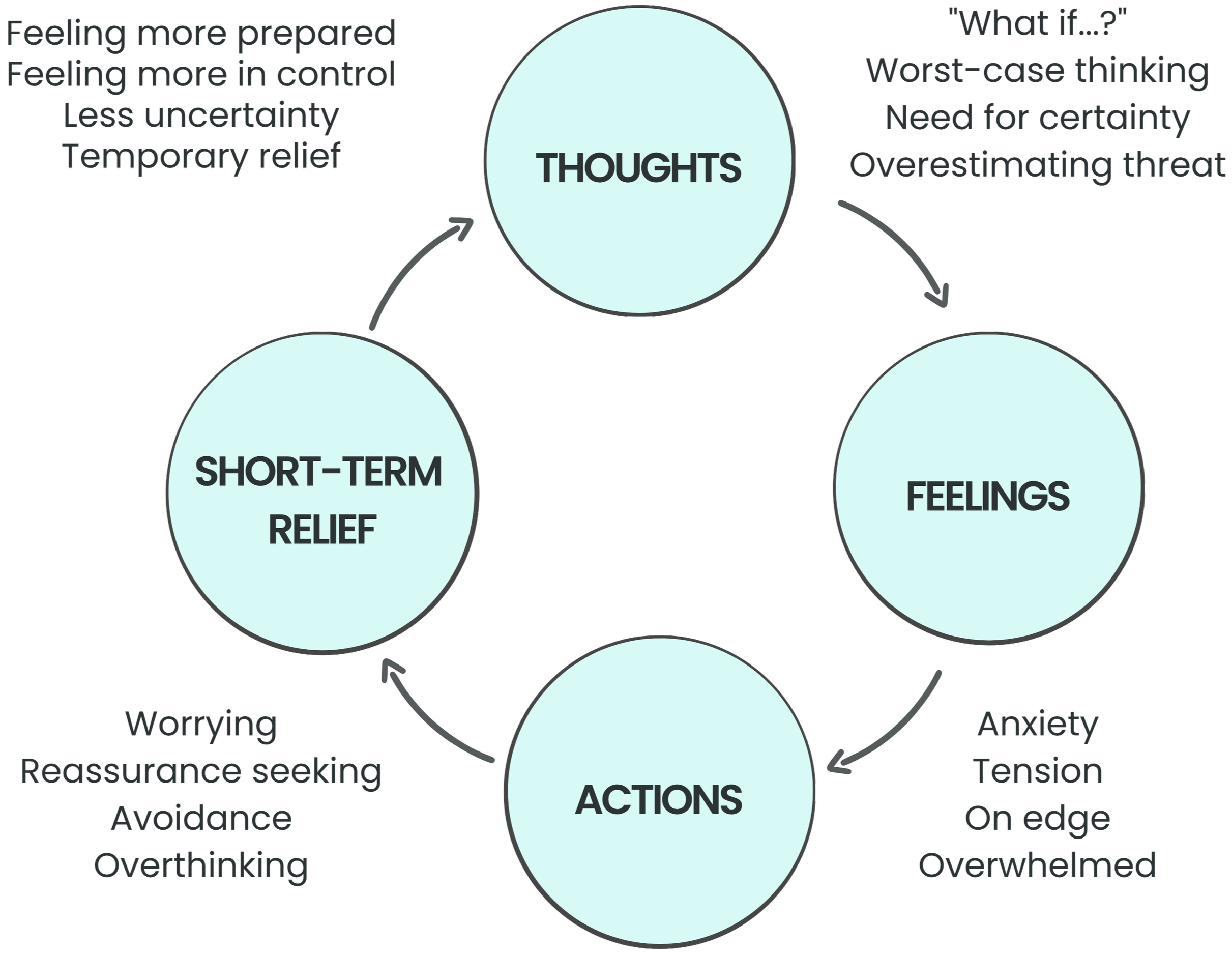
Worry often feels helpful.
It creates a temporary sense of being more prepared, more in control, and less uncertain.
Unfortunately, that short-term relief teaches your brain that worrying works, making it more likely you'll worry the next time uncertainty appears.
Over time, this cycle keeps anxiety going.
CBT helps break the cycle—not by eliminating uncertainty—but by changing how you respond to it.
Why Does Anxiety Grow?
One way I explain anxiety is with a simple formula:
Overestimation of Threat
+
Underestimation of Your Ability to Cope
Anxiety
When we overestimate how dangerous a situation is and underestimate our ability to handle it, anxiety naturally increases.
Want to understand why avoidance can make anxiety stronger? Read more about how avoidance keeps anxiety going—and what to do instead.
CBT helps us address both sides of the equation by learning to evaluate situations more realistically while building confidence in our ability to cope—even when life is uncertain.
How CBT Can Help
Rather than trying to eliminate anxiety, CBT helps you develop a different relationship with worry and uncertainty.
Treatment may include learning to:
Recognize worry patterns
Separate productive problem solving from unproductive worry
Build tolerance for uncertainty
Challenge unhelpful thinking habits
Reduce reassurance seeking
Practice behavioral experiments
Return your attention to what matters most
Sometimes anxiety gets worse before it gets better as you begin practicing new skills and facing situations you've been avoiding. While that can feel uncomfortable, it's often a normal part of treatment—and it does get better.

"The goal isn't to stop anxiety. It's to help you do what you want to do despite anxiety."
Living with constant worry can be exhausting. Many people spend years trying to think their way out of anxiety, only to find themselves worrying even more.
Recovery doesn't mean you'll never feel anxious again. It means anxiety no longer gets to make your decisions.
As you build confidence in your ability to handle uncertainty, you'll spend less time worrying and more time doing the things that matter most to you.
Common Questions About Generalized Anxiety Disorder
It's natural to have questions before starting therapy. Here are answers to a few of the questions I hear most often.
-
Everyone worries from time to time. Worry can even be helpful when it motivates us to solve problems or prepare for important situations.
With Generalized Anxiety Disorder (GAD), however, worry becomes excessive, difficult to control, and starts interfering with your daily life. You may find yourself worrying about one thing after another, feeling like your mind is always searching for the next problem to solve.
Therapy can help you learn to respond differently to worry so it no longer controls your life.
-
Sometimes it can.
As you begin practicing new skills, reducing reassurance seeking, or learning to tolerate uncertainty, your anxiety may temporarily increase. While that can feel uncomfortable, it's often a normal part of treatment.
The goal isn't to stop anxiety. The goal is to help you do what you want to do despite anxiety.
As you build confidence in your ability to handle uncertainty instead of trying to eliminate it, anxiety often becomes much more manageable.
-
Every person's situation is different, but many people begin noticing meaningful progress within the first several weeks of treatment.
A typical course of CBT for anxiety ranges from 12–28 sessions, depending on the severity of symptoms, your treatment goals, and any co-occurring concerns. After the assessment, I'll have a much better idea of what treatment may look like for you.
Some people also choose to continue therapy beyond that for ongoing support, maintenance, or accountability.
-
If it were that simple, you probably would have already done it.
Worry often provides a temporary sense of being more prepared, more in control, or less uncertain. Because it feels helpful in the moment, your brain learns to keep using it—even though it ultimately makes anxiety worse.
CBT helps you break this cycle by changing how you respond to worry rather than trying to force yourself to stop worrying.
Ready to Break Free from Constant Worry?
Living with chronic worry can feel overwhelming, but you don't have to face it alone.
Together, we'll work toward helping you respond differently to anxiety, build confidence in your ability to handle uncertainty, and spend more time focused on what matters most.