
Social Anxiety Disorder
When It feels like everyone is watching

Social anxiety isn't simply being shy or quiet.
It's the constant feeling that you're being watched, judged, or evaluated—and the exhausting effort to avoid saying, doing, or showing anything that might lead to embarrassment.
Over time, fear of judgment can begin deciding what you say, where you go, who you spend time with, and even the opportunities you allow yourself to pursue.
The good news is that social anxiety is highly treatable. With evidence-based Cognitive-Behavioral Therapy (CBT) and Exposure and Response Prevention (ERP), you can learn to feel more confident, connect more authentically with others, and stop letting anxiety decide how you live your life.

What is Social Anxiety?
Social anxiety is much more than feeling nervous before speaking in front of a group. Many people worry that they'll say the wrong thing, appear awkward, blush, shake, stumble over their words, or somehow embarrass themselves.
As a result, they may avoid conversations, social gatherings, public speaking, asking questions, dating, eating in front of others, or trying new experiences.
Over time, life can become organized around avoiding discomfort instead of pursuing meaningful relationships and experiences. While avoidance may reduce anxiety in the moment, it also prevents you from discovering something important:
Most people aren't judging you nearly as much as anxiety would have you believe.
Why Social Anxiety Sticks Around
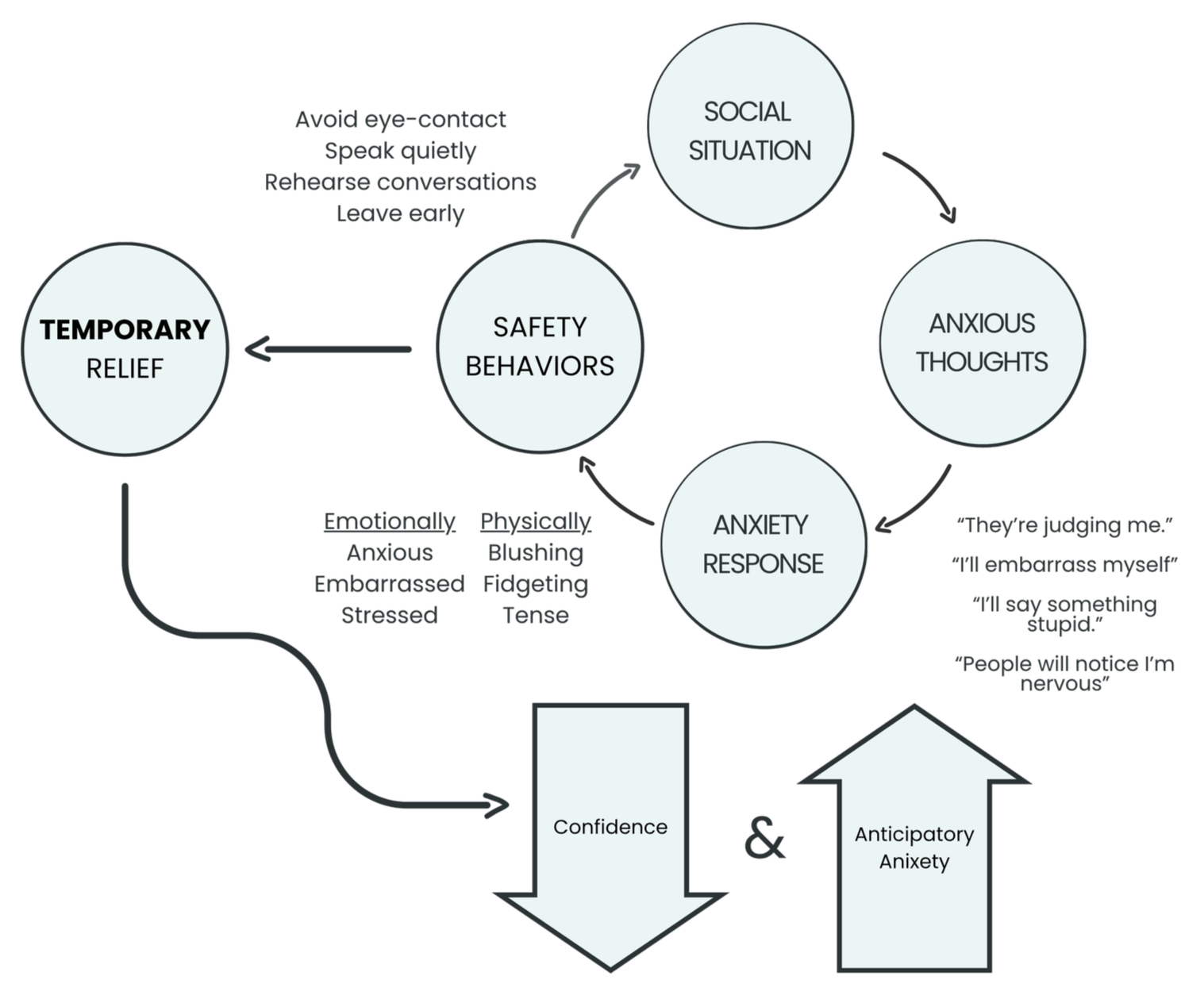
Social anxiety isn't maintained because you're socially incapable. It's maintained because anxiety changes how you think and how you behave. You may begin predicting negative outcomes before conversations even happen. During interactions, your attention shifts inward - Monitoring your thoughts, body language, and how you think you’re coming across - instead of staying engaged in the conversation itself. This is what is commonly referred to as self-focused attention.
Afterward, you may replay the conversation repeatedly, searching for mistakes or signs that someone judged you negatively. Meanwhile, avoiding social situations or relying on safety behaviors prevents your brain from learning that you can handle discomfort.
Instead of gaining confidence...
your brain learns to keep sounding the alarm.
The Social Anxiety Cycle
How CBT and ERP Can Help
Together we'll work to:
◌ Understand how anxiety affects your thinking
◌ Reduce self-focused attention
◌ Challenge unrealistic predictions
◌ Gradually face feared social situations
◌ Build confidence through experience
Instead of trying to eliminate anxiety before participating in life, treatment helps you gradually approach the situations you've been avoiding.
Each experience becomes an opportunity for your brain to learn something new:
◌ You don't have to be perfect to
connect with people.
◌ You don't have to eliminate anxiety
before living your life.
◌ You are far more capable than anxiety would have you
believe.
Building Confidence
By responding differently, the cycle begins to change. Rather than avoiding anxiety or relying on safety behaviors, CBT and Exposure and Response Prevention (ERP) help you gradually approach the situations you've been avoiding. Each experience becomes an opportunity for corrective learning, helping your brain discover that you can handle discomfort, that anxiety naturally decreases over time, and that the outcomes you fear are often less likely—or more manageable—than anxiety predicted.
The goal isn't the complete absence of anxiety—it's growing confidence in your ability to handle it.
"Confidence doesn't come before doing something difficult. Confidence grows because you're willing to do difficult things."
Building Confidence is Possible
Social anxiety can make it feel as though everyone is watching. Over time, that fear can begin to shrink your world, making it easier to avoid situations than risk feeling uncomfortable or judged.
The encouraging news is that change is possible. You don't have to wait until anxiety disappears before living the life you want. As you begin responding differently to anxiety, you'll discover that confidence grows through experience—not perfection.
With practice, many people find they become more comfortable speaking up, trying new things, and being themselves around others. The goal isn't to become the loudest person in the room—it’s to be yourself despite anxiety.
Common Questions About
Social Anxiety
It's natural to have questions before starting therapy. Here are answers to a few of the questions I hear most often.
-
Not necessarily. While some people with social anxiety are naturally shy, many are outgoing, funny, and enjoy spending time with others. The difference is that social anxiety is driven by an intense fear of being judged, embarrassed, or negatively evaluated, which can make even everyday interactions feel exhausting. It isn't about who you are—it's about how anxiety is influencing your behavior.
-
No. Treatment is collaborative and moves at a pace that's challenging but manageable. Together, we'll create a plan based on your goals and gradually practice facing situations that are important to you. The objective isn't to overwhelm you—it's to help you build confidence through repeated, meaningful experiences.
-
That's okay. In fact, those moments can become some of the most valuable opportunities for learning. Therapy isn't about performing perfectly—it's about discovering that you can handle discomfort, respond with self-compassion, and continue moving forward even when things don't go exactly as planned.
Many people are surprised to discover that the situations they feared most are often far more manageable than anxiety predicted.
-
Treatment often ranges from 12–28 sessions, although everyone's journey is different. After the assessment, I'll have a much better sense of what treatment may look like for you. Some people choose to continue beyond that for additional support, continued growth, or accountability as they work toward longer-term goals.
Ready to Feel Comfortable Being Yourself?
If social anxiety is interfering with your life or your child's life, I'd be honored to help.
Together, we'll build the skills and confidence needed to reduce anxiety and avoidance, feel more comfortable being yourself, and create a life guided by your values—not your anxiety.