
“What if my anxiety never goes away?”
It's a question I hear in therapy, and my answer sometimes surprises people.
It probably won't. At least, not completely.
I wish I could wave a magic wand and make your anxiety disappear. I really do. But not only would that be unrealistic, it wouldn't necessarily be a good thing.
Anxiety is part of being human. It serves an important purpose.
The goal of anxiety treatment isn't to eliminate anxiety. It's to help you develop the tools and confidence to live the life you want, even when anxiety shows up.
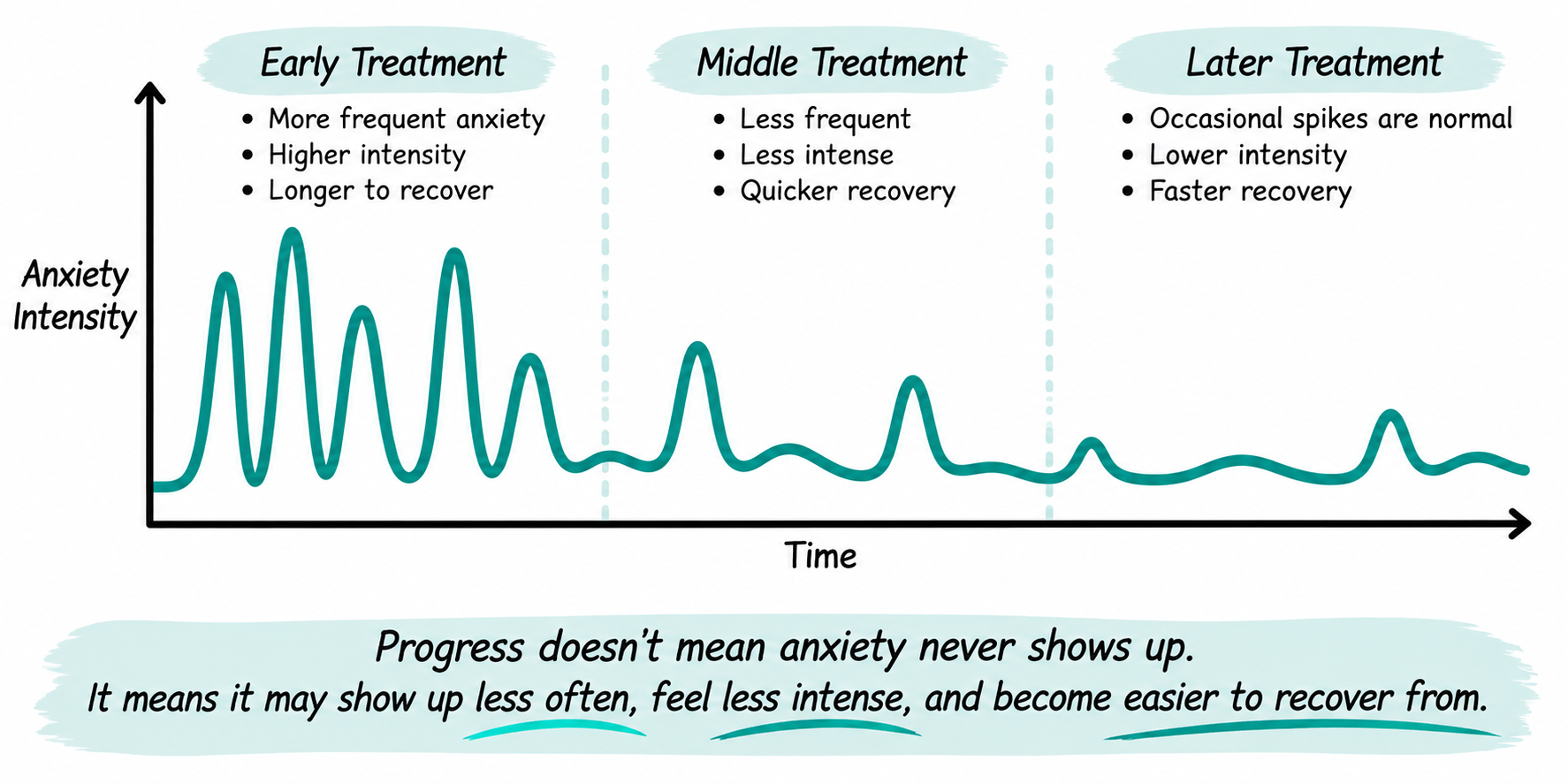
And here's the cool thing: As you learn to do that, anxiety often starts showing up less frequently, feels less intense, and becomes easier to recover from.
But first, we need to understand why anxiety exists in the first place.
Anxiety Isn't the Enemy
Have you seen Inside Out 2?
One thing I appreciate about the movie is how it distinguishes fear from anxiety.
Fear helps us respond to danger that's happening right now. Anxiety helps us anticipate danger that might happen in the future.
Both serve a purpose.
Think about crossing the street.
Before stepping into the road, you look left, right, and left again. Your brain is doing its job, helping you recognize potential danger and make a safe decision.
But what happens if you look left, right, and left again… and again… and again?
At some point, all that checking isn't making you significantly safer. It's keeping you from crossing the street.
You might even miss your opportunity to cross.
We don't want to stop looking both ways. We want to be able to cross the street.
That's what anxiety treatment is about.
We're not trying to get rid of the system that keeps us safe. We're helping your brain learn when that system is being helpful and when it's getting a little carried away.
When Anxiety Starts Running the Show
Anxiety becomes a problem when we start treating the possibility of danger as though it's a certainty.
We might overestimate how likely something bad is to happen or how terrible the consequences would be.
At the same time, we underestimate our ability to cope if something difficult does happen.
Maybe you avoid a social event because you're worried you'll say something embarrassing.
Maybe you put off making a decision because you can't be certain it's the right one.
Or maybe you wait until you feel calm before doing something that makes you anxious.
The problem?
Waiting for anxiety to go away can become the very thing that keeps you stuck.
The more we avoid situations because of anxiety, the fewer opportunities we have to learn that we can handle them.
And sometimes the things we do to feel better are actually making anxiety stronger.
When Coping Tools Become Safety Behaviors
One of the trickier parts of anxiety treatment is recognizing the difference between a coping tool and a safety behavior.
A safety behavior is something we do to reduce anxiety or feel protected in the moment, but that can strengthen anxiety in the long run.
Some safety behaviors are obvious, like avoiding a situation altogether.
Others are much more subtle.
Maybe you fidget to manage discomfort. Maybe you carry an emergency first aid kit everywhere. Or maybe you have an emotional support water bottle that absolutely must accompany you.
Now, there's nothing inherently wrong with carrying water, having a first aid kit, or fidgeting.
What matters is why you're doing it.
Do you simply enjoy having your water bottle with you? Or do you believe you won't be able to handle the situation without it?
Sometimes a coping tool and a safety behavior can look almost identical from the outside.
Here's an example.
Imagine someone feeling anxious and repeatedly telling themselves:
“I'M FINE! I'M FINE! I'M FINE! I'M FINE!”
They're trying desperately to convince themselves that everything is okay.
But what message is their brain actually receiving?
I'm clearly not fine, or I wouldn't need to keep convincing myself.
Now imagine that same person taking a moment and calmly reminding themselves:
“I'm fine.”
Then they continue with what they were doing, even if some anxiety remains.
The words are almost identical, but the purpose behind them is very different.
One is an attempt to make anxiety disappear. The other is a way to acknowledge the situation and move forward.
The goal isn't necessarily to feel better immediately. It's to get better at handling how you feel.
How Do You Know Therapy Is Working If You're Still Anxious?
This is where I encourage clients to look at progress a little differently.
If your only measure of success is whether you experienced anxiety today, you're going to miss a lot of meaningful progress.
Instead, I look at four things.
1. Frequency: How often is anxiety showing up?
Maybe you used to experience anxiety multiple times a day, and now it happens a few times a week.
2. Intensity: How strong is the anxiety when it shows up?
Maybe situations that once felt completely overwhelming are now uncomfortable but manageable.
3. Recovery time: How quickly do you bounce back?
Maybe anxiety used to derail your entire day. Now you can experience it, respond, and return to what you were doing much more quickly.
4. Access to your tools: How easily and effectively can you use the skills you've learned?
Maybe you used to need someone to walk you through what to do when anxiety appeared. Now you recognize what's happening and know how to respond.
These are all signs of progress.
And progress doesn't always look like a straight line.
A Spike in Anxiety Doesn't Mean You're Back at Square One
Imagine you've been doing really well.
You're using your tools, doing things you previously avoided, and feeling more confident.
Then something stressful happens.
Maybe it's a major life change. Maybe you encounter a situation you haven't faced in a while. Or maybe you've gotten out of the habit of practicing some of your skills.
Suddenly, anxiety feels louder again.
It's easy to think:
“I thought I was better. Why is this happening again?”
But a spike in anxiety doesn't mean you've lost all your progress.
It might mean you need to revisit a tool, practice a skill you haven't used recently, or figure out how to apply something you've learned to a new situation.
Think about learning to ride a bike.
If you haven't ridden in years, you might feel a little wobbly when you get back on. You may need a few minutes to get comfortable again.
That doesn't mean you're starting from scratch.
The same is true for managing anxiety.
A setback isn't the same as starting over.
My Goal Is to Make You Your Own Best Therapist
I don't want my clients to need therapy forever.
My job is to help you become your own best therapist.
That means developing the skills to recognize what's happening, understand how anxiety works, and respond effectively when it shows up.
It means knowing when anxiety is giving you useful information and when it's overestimating danger.
It means recognizing when you're avoiding something because you're afraid, and having the confidence to move forward anyway.
And it means understanding that sometimes anxiety will show up, even when you're doing everything right.
The goal isn't to prevent every anxious moment.
It's to know that you have the tools to handle anxiety when it does show up.
That's what freedom from fear means to me.
Not the complete absence of anxiety, but the confidence that anxiety doesn't get to make your decisions for you.
Anxiety Can Be a Fact of Life Without Becoming the Fact of Your Life
Of course you want your anxiety to go away.
Anxiety is uncomfortable! Nobody enjoys feeling afraid, uncertain, or overwhelmed.
But anxiety is also a fact of life.
And if avoiding it, fighting it, or constantly trying to make it disappear hasn't worked so far, maybe it's time to try something different.
Instead of asking:
“How do I make sure I never feel anxious again?”
What if you started asking:
“How can I live the life I want, even when anxiety shows up?”
Because the goal isn't to spend your life managing anxiety.
The goal is to spend your life living.
Anxiety may always be a fact of life.
But it doesn't have to be the fact of your life.
Ready to Change Your Relationship With Anxiety?
If anxiety is keeping you from doing the things you want to do, cognitive behavioral therapy (CBT) and exposure and response prevention (ERP) can help.
At Bridges CBT, I help children, teens, and adults develop practical skills to face anxiety, build confidence, and reclaim their freedom.
You don't have to wait until anxiety disappears to start living the life you want.
This article is for educational purposes and is not a substitute for individualized mental health care.